 Simulacra
Calibration
See how well the chances you stated on your posts matched what happened, and resolve the predictions that are due.
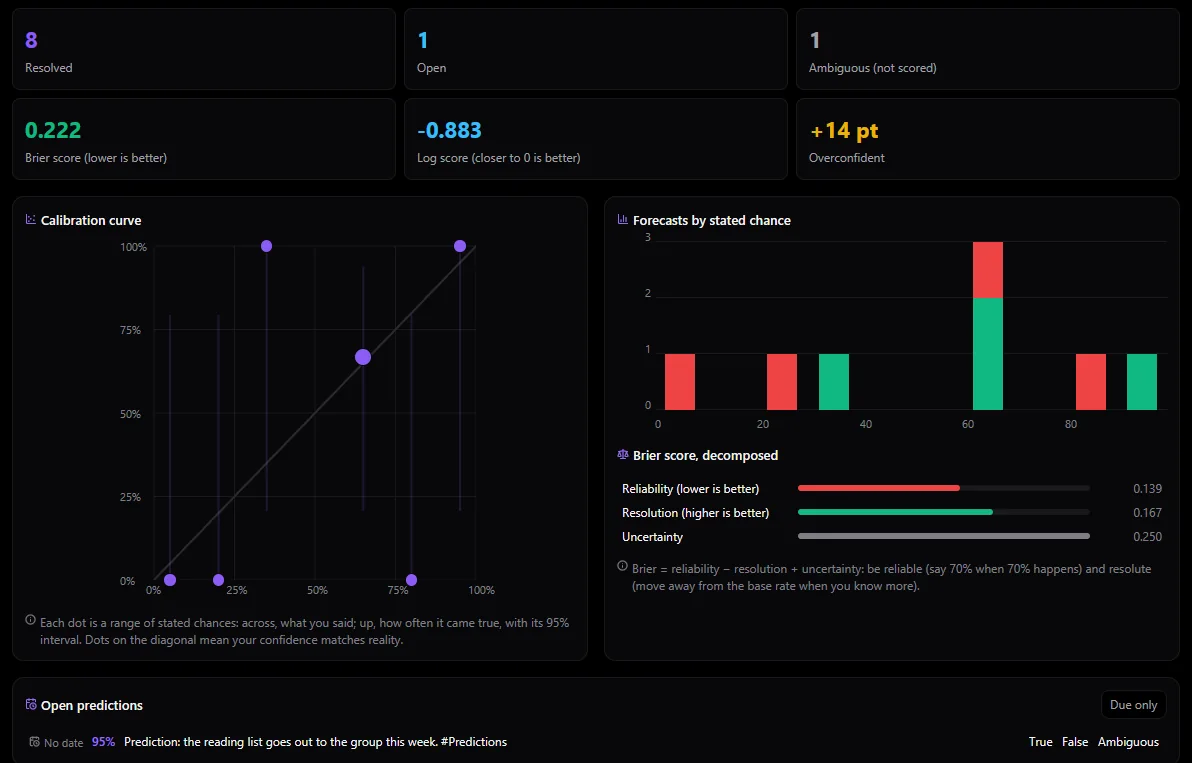
Calibration scores your credences. Each time you give one of your posts a chance of being true and later resolve it, Simulacra learns a little about your judgement: whether things you call 70% likely happen about 70% of the time. This tab shows the result and lists the predictions still open.
Open it
- The Calibration tab of Insights, or the palette command Insights: calibration.
- The palette command Resolve due predictions opens it with Due only switched on.
Calibration uses every credence you have set, in every network. The filter bar is not shown here.
Key numbers
| Tile | Meaning |
|---|---|
| Resolved | Predictions resolved true or false: the ones that are scored. |
| Open | Predictions not resolved yet. |
| Ambiguous (not scored) | Resolved as ambiguous: closed, but left out of every score. |
| Brier score (lower is better) | The mean squared distance between what you said and what happened. 0 is perfect; always saying 50% earns 0.25; being sure and wrong every time earns 1. |
| Log score (closer to 0 is better) | The mean base-2 logarithm of the chance you gave to what actually happened. 0 is perfect; always saying 50% earns −1. It punishes confident misses much harder than the Brier score. |
| Confidence | Overconfident, Underconfident or Well calibrated, with the gap in points, such as +12 pt. |
The confidence gap is how sure you were, on average, of the side you leaned to, minus how often that side turned out right. A gap within five points counts as well calibrated. Predictions of exactly 50% lean nowhere and are left out of it.
Calibration curve
Across: the chance you stated. Up: how often those claims came true. The diagonal is perfect calibration. Your forecasts are grouped into tenths (0–10%, 10–20%, …), and each group with at least one forecast is a dot at its mean stated chance and its observed frequency; bigger dots hold more forecasts. The vertical whisker is the 95% Wilson interval: with few forecasts it is long, meaning the dot could easily sit elsewhere.
- Dots below the diagonal on the right: things you called likely happened less often than you said (overconfidence).
- Dots above the diagonal on the left: things you called unlikely happened more often than you said.
Forecasts by stated chance
One column per tenth of stated chance, split into the forecasts that held (success colour) and the ones that failed (danger colour). Hover a column for, for example, "Said 70–80%: 3 of 4 came true".
Brier score, decomposed
Under the histogram, three bars split the Brier score (Murphy's decomposition):
| Bar | Meaning |
|---|---|
| Reliability (lower is better) | How far each group's stated chance is from what happened in it. This is the calibration error. |
| Resolution (higher is better) | How much your groups differ from the overall rate of things coming true: whether your forecasts tell cases apart. |
| Uncertainty | How hard the questions were in themselves, whatever you said. |
Brier = reliability − resolution + uncertainty: say 70% when 70% happens, and move away from the base rate when you know more.
Open predictions
The bottom card lists your open predictions, dated ones first and soonest due first. Each row shows the "resolves by" date (in the warning colour when the date has come, No date otherwise), your stated chance, the post's opening words and three buttons: True, False, Ambiguous.
| To | Do this |
|---|---|
| Resolve a prediction | Click True, False or Ambiguous on its row. It leaves the list and the scores update. |
| See only what is due | Turn on the Due only chip in the card's title. |
| Read the post first | Click its opening words to open the post. |
Resolving here leaves no note. To add one ("What happened?"), resolve from the post's credence chip instead; see Credences and predictions.
Empty states
| You see | Because |
|---|---|
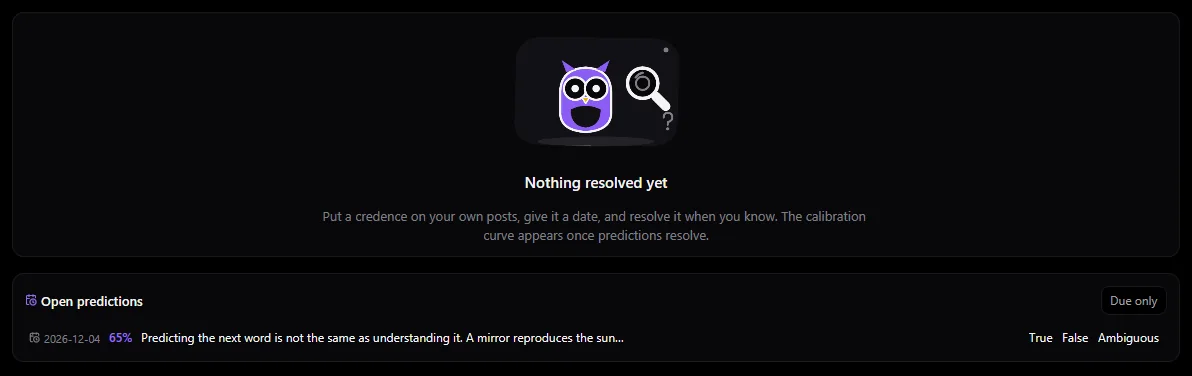
| Nothing resolved yet | No prediction is resolved true or false. The open predictions are still listed below. |
| No open predictions. Set a credence on one of your posts from its “…” menu. | You have no open credence. |
| No predictions are due. | Due only is on and nothing has reached its date. |
Related
- Credences and predictions: setting and resolving a credence.
- Beliefs and credence: why proper scores and calibration matter.
- Map an argument: a walk-through that ends here.