 Simulacra
Categories
View the network as a category, with kinds of items as objects and typed relations as arrows, and see which two-step paths are common and which close into squares.
Categories draws the network's grammar rather than its items: which kinds of things relate to which, by what relation, and how relations chain. It is category theory made concrete: objects are the kinds of items, arrows are their typed relations, and following one relation after another composes them.
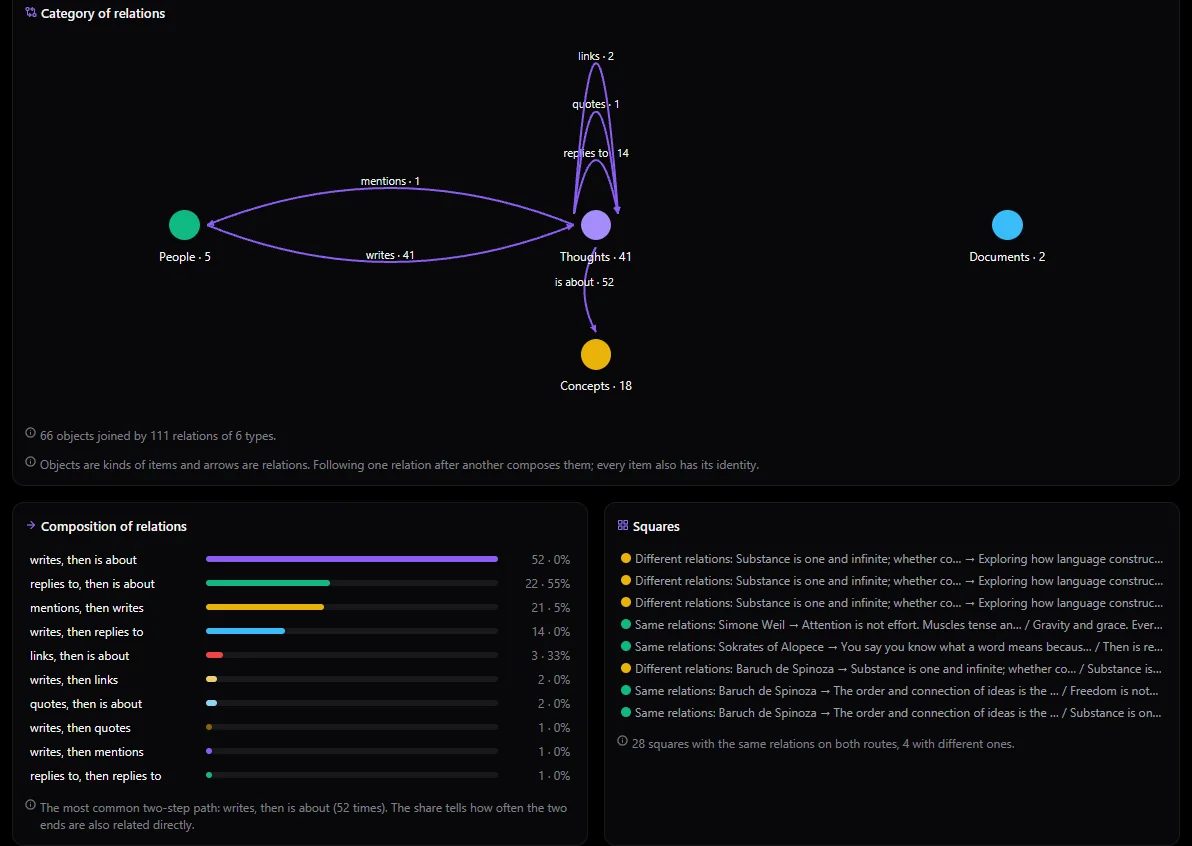
Category of relations
The diagram has four objects, each sized and labelled with its count: Thoughts in the middle, Documents to the right, Concepts below and People to the left, in the Mind Graph's colours. Each arrow is one type of relation between two kinds, labelled with its name and how many such relations exist, for example replies to · 12. Relations from a kind to itself, such as a thought replying to a thought, are loops stacked above the object. Hover an object to highlight its arrows and fade the rest.
| Arrow | From → to | Comes from |
|---|---|---|
| writes | People → Thoughts | Every post's author. |
| replies to | Thoughts → Thoughts | A reply. |
| quotes | Thoughts → Thoughts | A quote. |
| reposts | Thoughts → Thoughts | A repost. |
| links | Thoughts → Thoughts | A wikilink to a post. |
| cites | Thoughts → Documents | A wikilink to a vault document. |
| is about | Thoughts → Concepts | A hashtag. |
| mentions | Thoughts → People | An @mention. |
The summary counts objects, relations and relation types; the card adds that every item also has its identity (the empty path), which is what makes this a category.
Composition of relations
Two relations compose when the end of one is the start of the other: a person writes a thought that is about a concept gives the path "writes, then is about". The Composition of relations list ranks the ten most common two-step paths. Each row shows how many such paths there are and, after the dot, the share whose two ends are also related directly.
A high share says the shortcut is usually there already: the two ends are linked directly as well. A low share points at connections that exist only through the middle step, which are good places to add a direct link if it matters.
Squares
A square is two different two-step paths between the same pair of items, x → y → z and x → y′ → z. The Squares card lists up to eight examples:
| Badge | Meaning |
|---|---|
| Same relations | Both routes carry the same relations (the square commutes in type). |
| Different relations | The routes use different relations to reach the same place. |
Click a square to open the item it starts from. The summary counts both kinds.
Tips and limits
- Without any relation in the period, the tab shows No relations yet: replies, quotes, links and concepts become the arrows.
- To keep large networks quick, at most two million two-step paths are counted.
Related
- Nodes and links: the relations behind the arrows.
- Network: the same relations as one graph.