 Simulacra
Statistics
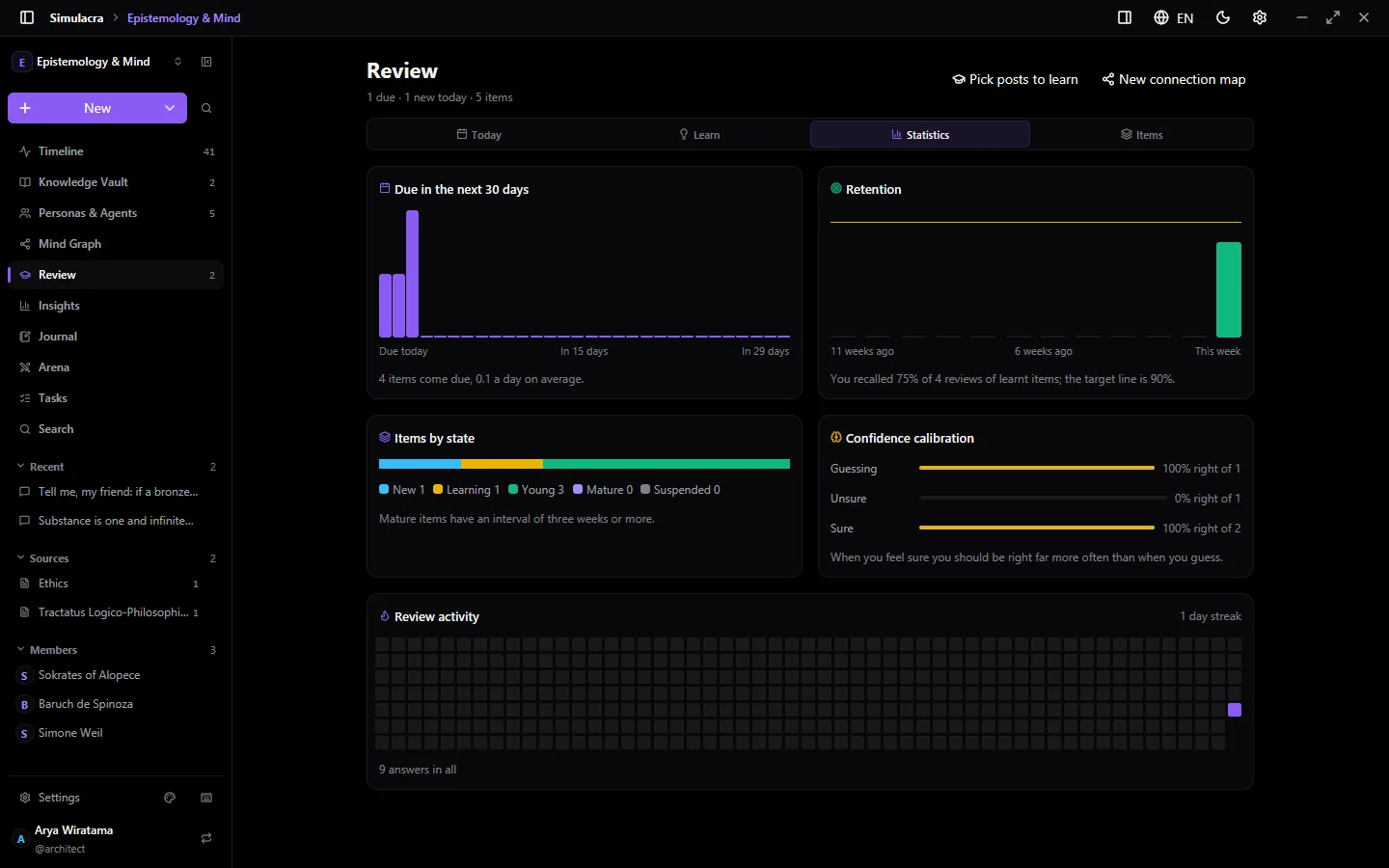
The due forecast, true retention against your target, items by state, confidence calibration and the review heatmap.
The Statistics tab shows how your memory of this network is doing and what is coming. Every chart is computed from your items and the log of your answers, nothing else.
Open it
Click the Statistics tab on the Review page, or Statistics on a session's summary. Hover a bar or a cell for its exact figures.
The panels
| Panel | Shows | Caption |
|---|---|---|
| Due in the next 30 days | One bar per day, today first; overdue items count towards today. Suspended and new items are left out. | "N items come due, N a day on average." |
| Retention | One bar per week for the last 12 weeks: the share of reviews of learnt items that were recalled, with a line at your desired retention. | "You recalled N% of N reviews of learnt items; the target line is N%." Before any learnt item comes back: Retention appears once learnt cards come back for review. |
| Items by state | One bar split into New, Learning, Young, Mature and Suspended, with counts. | Mature items have an interval of three weeks or more. |
| Confidence calibration | For Guessing, Unsure and Sure: how often a multiple-choice answer given at that confidence was right ("N% right of N"). | When you feel sure you should be right far more often than when you guess. Before any rating: Rate your confidence in multiple choice to see how well it predicts your answers. |
| Review activity | A heatmap of answers per day, one column per week (Monday on top), as many recent weeks as fit, up to a year. | The current streak ("N day streak") and "N answers in all". |
Reading them
- Retention counts only reviews of items that were already learnt. Answers to new or relearning items say little about long-term memory, so they are left out. The target line is the Desired retention of Settings › Learning: the recall chance each item is scheduled for.
- States: Learning covers items seen but not yet recalled on a later day, and items forgotten after being learnt. Young items have an interval under 21 days.
- The streak counts consecutive days with at least one answer, ending today, or yesterday while today has none yet.
- The heatmap shades each day by its share of your busiest day.